
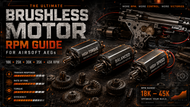
If you read our brushless motor buyer's guide, you already know which brand fits your budget, whether that's a budget-friendly Lei Ying, a proven T238, or a premium ADV. But picking a brand only answers half the question. Every brushless motor on the market ships in multiple RPM classes, usually 25K, 28K, 31K, and 35K, and that number matters just as much as the brand stamped on the case.
RPM class determines torque, amp draw, and how your motor behaves once it's paired with your gear ratio, spring, and battery voltage. Get it wrong and even a premium motor can end up straining harder than it should. To settle the question with data instead of guesswork, our technicians ran a full bench-testing program: four brushless RPM classes against a brushed baseline, three gear ratios, five spring/FPS setups, and three LiPo voltages. Here's what actually happened on the bench, and which class you should be running.
Why RPM Class Is the Real Decision
Brand determines build quality and support. RPM class determines physics. A higher RPM motor spins faster but trades away torque, which means more amp draw for the same job. A lower RPM motor holds torque better and runs cooler, but caps out your rate of fire. That tradeoff hasn't changed since the brushed-motor era, brushless designs just make the numbers smaller across the board.
Here's the baseline finding from our testing: on semi-auto engagement, every brushless motor pulled meaningfully less current than a brushed motor, regardless of RPM class.
| Motor | Avg. Full-Auto Amp Draw |
|---|---|
| 25K Brushless | 14.9A |
| 28K Brushless | 16.8A |
| 31K Brushless | 18.7A |
| 35K Brushless | 21.4A |
That's the universal brushless advantage. Everything past this point is about how RPM class changes the picture once the trigger is held down.
How We Tested
Our technicians tested four brushless RPM classes (25K, 28K, 31K, and 35K) against a 19K brushed baseline. Each motor ran across three gear ratios (18:1, 16:1, and 13:1), five spring/FPS setups (330-410 FPS), and three battery voltages (7.4V, 9.6V, and 11.1V), logging semi and full-auto amp draw, no-load RPM, and load RPM under spring resistance. Motors were selected to isolate RPM class as the variable under test: the 25K, 31K, and 35K data come from Solink motors, while the 28K data point comes from T238's lineup.
Averaged across every test condition, full-auto amp draw scaled directly with motor speed, confirming that lower RPM equals higher torque, and higher torque equals better efficiency, the same rule that's always applied to AEG motors.
| Motor | Avg. Full-Auto Amp Draw |
|---|---|
| 25K Brushless | 14.9A |
| 28K Brushless | 16.8A |
| 31K Brushless | 18.7A |
| 35K Brushless | 21.4A |
The 25K motor consistently drew the least current of any brushless option tested. The 35K pulled the most in every single configuration, roughly 43% more current on average than the 25K, and that gap widens further under the toughest gear ratio (13:1): an average of 17.9A for the 25K versus 26.0A for the 35K, a 45% draw penalty for a motor spinning about 40% faster.
RPM Class Breakdown: What Each One Is Actually For
25K Brushless: The Torque-Focused Pick
Avg. Full-Auto Draw: 14.9A | Best For: stock upgrades, heavy springs, and efficiency-first builds
The 25K posted the lowest amp draw of any brushless motor in every test condition, averaging 14.9A on full-auto and just 10.1A on semi. It handled a 400 FPS spring at an easy 18:1 gear ratio while pulling only 14A on full-auto at 11.1V, making it the clear pick for setups where efficiency and battery life matter more than raw rate of fire.
What You Get
- The lowest amp draw of any brushless class tested, at every gear ratio and voltage
- Comfortable handling of 400+ FPS springs without pushing into high-draw territory
- Best-in-class semi-auto efficiency, at just 10.1A average
What You Don't Get
- The fastest cycle rate. If rate of fire is the priority, this isn't the class for it.
28K Brushless: The Balanced Upgrade
Avg. Full-Auto Draw: 16.8A | Best For: general-purpose builds, players who want a step up from 25K
Sitting between the 25K and 31K, the 28K averaged 16.8A on full-auto. It's a solid middle-ground option for players who want a noticeable trigger-response and rate-of-fire bump over a 25K without moving all the way up to the 31K's amp draw.
What You Get
- A meaningful ROF step up from the 25K without the steeper draw penalty of the 31K
- Still a comfortable 34% lower semi-auto draw than a brushed motor
What You Don't Get
- The absolute best efficiency (that's the 25K) or the best overall balance (that's the 31K)
31K Brushless: The Balance King
Avg. Full-Auto Draw: 18.7A | Best For: most custom builds
The 31K averaged 18.7A on full-auto, with an RPM retention of 88.4% at 11.1V. It's the technician's preferred recommendation for custom builds because it balances rate of fire, torque, and reliability without pushing into the steep amp-draw penalty seen on the 35K.
What You Get
- The strongest load-bearing performance in the lineup, meaning it retains its rated RPM better than all others, even under load
- A real rate-of-fire advantage over the 25K/28K classes
- The technician's default recommendation when a build doesn't have a specialized requirement
What You Don't Get
- 25K-level efficiency. You're trading some amp draw for the extra speed.
35K Brushless: Specialized Builds Only
Avg. Full-Auto Draw: 21.4A | Best For: CQB, high-speed niche builds
With the highest amp draw across every test, peaking at 32A in the toughest configuration, the 35K is best leveraged using standard ratio gear sets like 18:1 where the higher, slower ratio of gears helps balance the torque load put on the motor, allowing it to operate closer to its peak efficiency. In the toughest single configuration we tested (13:1 gear ratio, 400 FPS spring), the 35K peaked at that 32A figure, roughly double what the 25K pulled in the same setup, for a rate-of-fire gain that doesn't come close to doubling. This result highlights the importance of choosing the right motor and gears for your desired performance target. Premium options like the GATE G5 Smart Brushless Motor are engineered for this kind of load, but that comes at a cost, and it's still a niche choice rather than a drop-in stock upgrade.
What You Get
- The highest base RPM, trading efficiency for maximum rate of fire in specialized builds
- A high rate of fire for builds that can't run low-ratio gears to get their speed from the gearbox
What You Don't Get
- Efficiency. It should not be treated as a default AEG upgrade, and it failed to justify its extra draw against heavy springs or tight gear ratios in testing.
Essential Supporting Components
An RPM class is only half the equation. Here's what needs to match it.
Gear Ratio
Gear ratio had the single largest effect on amp draw of any variable tested. Comparing a standard 18:1 gear set to high-speed 13:1 gears, which demand more torque from the motor, increased full-auto amp draw by up to 40% in certain high-stress setups. The outliers were the 25K and 28K motors, where the increased torque allowed them to efficiently handle the heavier load from the lower-ratio gears, even in high-FPS setups.
Battery Voltage
Meanwhile, voltage was the variable that most affected the overall rate of fire and how smoothly these motors ran. We measured this using RPM retention, or how fast the motor actually operated under real-world load compared to its advertised no-load speed. At 11.1V, brushless motors retained an average of roughly 86% of their advertised no-load RPM under load, compared to just 57% at 7.4V. While this isn't an indicator that a motor is struggling to keep up, it does demonstrate how battery voltage and output can dramatically affect performance. It also provides a useful estimate for players using lower-voltage batteries, helping them predict real-world motor speed instead of relying solely on advertised specifications.
| Voltage | Avg. RPM Retention Under Load |
|---|---|
| 7.4V | 0.568 (57%) |
| 9.6V | 0.626 (63%) |
| 11.1V | 0.855 (86%) |
If you're chasing efficiency gains from a brushless swap, pair it with an 11.1V LiPo battery. Technicians also noted these motors run noticeably quieter and with less mechanical strain at 11.1V versus lower voltages.
MOSFET
Brushless motors already control current ramp-up better than brushed motors, but pairing one with a quality MOSFET protects your trigger contacts further and lets you fine-tune rate of fire and trigger response on top of the motor's own gains.
Gearbox Fit
Most brushless motors, in any RPM class, work fine in a standard gearbox, but if you're running a heavily upgraded internal setup, confirm your shell and bushings can handle the gear ratio you're pairing with your motor choice.
Which RPM Class Is Right for You? The Honest Answer
- Running a stock AEG with a field-limit spring: Go 25K. It's the most efficient class tested and comfortably handles 400 FPS setups.
- Want a noticeable ROF bump without a big draw penalty: Go 28K. Balanced middle ground between the 25K and 31K.
- Building a general-purpose custom AEG: Go 31K. Best overall balance of speed, torque, and load-holding performance, and the technician's default pick.
- Running a short-stroked or highly customized build? Go with the 35K. Just don't expect great efficiency, and avoid installing it in a stock AEG or one running a very heavy spring.
- Not sure which spring or gear ratio you're running: Get it checked before buying. RPM class only performs as advertised when it's matched to the rest of your gearbox.
Final Recommendations
Based on the full testing data, here's the technician's recommendation priority order:
| Priority | RPM Class | Why |
|---|---|---|
| 1 | 31K Brushless | Best overall choice: balances ROF, torque, and the strongest load-holding performance in the lineup. |
| 2 | 25K Brushless | Best torque upgrade: lowest amp draw and cleanest handling of heavier 400 FPS springs. |
| 3 | 28K Brushless | Reliable, balanced middle-ground option. |
| 4 | 35K Brushless | Specialized builds only: higher amp draw is an intentional tradeoff. |
Brand still matters, and our brushless motor buyer's guide covers that side of the decision. But RPM class is what determines whether your new motor actually performs the way the spec sheet promises, and now you've got the bench data to choose the right one.
FAQ’s
What's the difference between a brushless and brushed airsoft motor?
A brushed motor uses carbon brushes that physically contact a spinning commutator, creating friction, heat, and wear over time. A brushless motor uses an electronic speed controller (ESC) to switch current to the stator windings with no physical contact point, eliminating arcing and wear while also controlling how current ramps up on trigger pull. That's why brushless motors pulled 18-44% less current on semi-auto than the brushed baseline in testing.
Which brushless motor RPM class should I buy for my AEG?
It depends on your build. The 25K is best for stock upgrades and heavier springs (400+ FPS) where efficiency matters most. The 31K offers the best overall balance of rate of fire, torque, and load-holding performance. The 28K is a solid middle ground, and the 35K should be reserved for specialized high-speed builds running light springs, since it draws significantly more current for a smaller rate-of-fire gain.
What voltage battery works best with a brushless airsoft motor?
An 11.1V LiPo produced the cleanest, most consistent results. Motors retained an average of roughly 86% of their no-load RPM under spring resistance at 11.1V, compared to just 57% at 7.4V. Technicians also noted motors ran quieter and with less mechanical strain at 11.1V versus lower voltages.
Does gear ratio affect brushless motor performance?
Yes, significantly. Amp draw increased roughly 40% just from moving to a high-speed 13:1 gear ratio, which demands more torque from the motor, compared to a standard 18:1 ratio. This effect compounds with motor speed: the gap between easy and hard gear ratios grows wider as RPM class increases, which is why pairing a 35K motor with a 13:1 gear set and a heavy spring creates the highest current draw recorded in testing.