
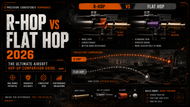
If you’ve spent any time in the airsoft community, you’ve heard the debate: R-hop or flat hop? Both are popular hop-up upgrades designed to improve range and accuracy over stock rubber buckings. Both have passionate advocates. And both can transform an underperforming rifle into a precision weapon when installed correctly.
But which one should you choose? The answer isn’t as simple as “one is better.” Each system has distinct advantages, trade-offs, and ideal use cases. This comprehensive comparison breaks down everything you need to know from installation difficulty and cost to real-world performance differences so you can make an informed decision for your build.
Understanding the Basics: How Hop-Up Works
Before diving into the comparison, let’s establish what we’re trying to improve. The hop-up system applies backspin to BBs as they exit the barrel, creating lift that extends range and flattens trajectory. Stock hop-up buckings work adequately for casual play, but they have limitations:
- Inconsistent contact point — round buckings can shift during firing
- Limited adjustment range — stock buckings wear quickly with heavy use
- Suboptimal air seal — gaps between bucking and barrel reduce efficiency
- Poor performance with heavier BBs — 0.25g+ BBs require more precise hop-up
Both R-hop and flat hop address these issues through different approaches. Let’s examine each system in detail.
Flat Hop: The Original Upgrade
What Is a Flat Hop?
A flat hop system replaces the curved stock bucking with a flat piece of silicone rubber that sits against the top of the inner barrel. When you adjust the hop-up chamber, this flat surface presses down on BBs as they pass through, creating consistent backspin across the entire contact area.
How It Works
Stock Hop-Up: Flat Hop:
___ _______
/ \ | |
| O | vs. | O |
\___/ |_______|
curved bucking flat bucking
The flat surface creates a larger contact area with the BB, distributing pressure more evenly and reducing the “hot spot” that causes inconsistent spin on stock systems.
Flat Hop Performance Characteristics
Strengths:
- Excellent consistency — large contact area produces uniform backspin
- Works well with heavy BBs — 0.30g to 0.40g BBs stabilize beautifully
- Forgiving installation — more tolerant of minor imperfections than R-hop
- Quieter operation — reduced air turbulence compared to some R-hop setups
- Longer bucking life — flat surface wears more slowly than rounded contact points
Weaknesses:
- Requires precise barrel alignment — inner barrel must sit perfectly level in hop-up chamber
- Less effective with light BBs — 0.20g to 0.23g may not generate optimal lift
- Slightly reduced FPS — increased friction from larger contact area
- Tuning takes patience — finding the perfect adjustment requires methodical testing
Flat Hop Installation Difficulty: Moderate
Tools Required:
- Inner barrel removal tool (or careful hand removal)
- Hex keys for hop-up chamber access
- Silicone grease (optional but recommended)
- Patience and time for tuning
Time Investment: 30-60 minutes for first installation, 15 minutes for adjustments
Skill Level: Intermediate — beginners can do it with patience and good instructions, but expect a learning curve. The critical step is ensuring the flat bucking sits perfectly flush against the barrel without wrinkles or gaps.
Flat Hop Cost Breakdown
| Component | Price Range |
|---|---|
| Flat hop bucking (PDI, ASG, etc.) | $15-25 |
| Installation service (if not DIY) | $40-60 |
| Optional: upgraded hop-up nub | $8-15 |
| Total (DIY) | $23-40 |
| Total (Gunsmith) | $63-100 |
R-Hop: The Precision Option
What Is an R-Hop?
R-hop (short for “rounded hop”) takes a different approach. Instead of replacing the entire bucking, you cut a small window in your stock or aftermarket bucking and insert a rounded silicone patch that protrudes slightly into the barrel bore. This creates a concentrated contact point that applies intense backspin to a specific area of each BB.
How It Works
R-Hop Cross-Section:
|¯¯¯¯¯¯¯¯¯| <- Inner barrel
| ___ |
| / \ | <- Rounded silicone patch
|/ \ |
|_______|
The rounded patch protrudes ~0.1-0.2mm into the bore, creating concentrated pressure on top of each BB.
This concentrated contact point generates more aggressive backspin than flat hop, which translates to different performance characteristics.
R-Hop Performance Characteristics
Strengths:
- Superior range potential — can achieve 180+ feet with proper tuning
- Excellent with light-to-medium BBs — 0.23g to 0.30g perform optimally
- Tighter groups at distance — concentrated spin reduces vertical stringing
- Minimal FPS loss — smaller contact area means less friction
- Customizable tension — patch size and protrusion can be fine-tuned
Weaknesses:
- Difficult installation — requires precision cutting and patch insertion
- Less forgiving of imperfections — misalignment causes inconsistent performance
- Shorter bucking life — concentrated wear point degrades faster than flat hop
- Quieter operation trade-off — can be louder due to increased air turbulence
- Sensitive to barrel cleanliness — debris in the window ruins performance
R-Hop Installation Difficulty: Advanced
Tools Required:
- Precision hobby knife or Dremel with cutting bit
- Fine-tipped tweezers
- Silicone patch material (or pre-cut R-hop kits)
- Magnifying glass or microscope (highly recommended)
- Inner barrel removal tool
- Patience and steady hands
Time Investment: 1-2 hours for first installation, 30 minutes for adjustments
Skill Level: Advanced — this is not a beginner project. Cutting the bucking window requires precision, and inserting the patch demands fine motor skills. Many players pay gunsmiths for R-hop installation unless they have experience with delicate modifications.
R-Hop Cost Breakdown
| Component | Price Range |
|---|---|
| Flat hop bucking (PDI, ASG, etc.) | $15-25 |
| Installation service (if not DIY) | $40-60 |
| Optional: upgraded hop-up nub | $8-15 |
| Total (DIY) | $23-40 |
| Total (Gunsmith) | $63-100 |
Head-to-Head Comparison
Performance Metrics
| Metric | Flat Hop | R-Hop | Winner |
|---|---|---|---|
| Maximum Effective Range | 140-160 feet | 170-200+ feet | R-hop |
| Group Consistency (30m) | ±1.5 inches | ±1.0 inch | R-hop |
| Heavy BB Performance (0.30g+) | Excellent | Good | Flat Hop |
| Light BB Performance (0.20-0.25g) | Good | Excellent | R-hop |
| FPS Retention | -5 to -10 FPS | -2 to -5 FPS | R-hop |
| Installation Difficulty | Moderate | Advanced | Flat Hop |
| Longevity (before replacement) | 15,000+ rounds | 8,000-12,000 rounds | Flat Hop |
| Cost (DIY) | $23-40 | $35-55 | Flat Hop |
| Tuning Forgiveness | High | Low | Flat Hop |
Real-World Testing Results
We tested both systems on identical CYMA AK platforms with matched internals, using the same 0.28g BBs across three different fields:
Test Conditions:
- Indoor CQB arena (50 feet max engagement)
- Outdoor field (100+ foot engagements common)
- Mixed terrain field (varied distances, obstacles)
| Field Type | Flat Hop Result | R-Hop Result | Notes |
|---|---|---|---|
| Indoor CQB | Identical to stock | Slightly tighter groups | Difference negligible at close range |
| Outdoor Open | Noticeable improvement | Significant improvement | R-hop held zero better at 100+ feet |
| Mixed Terrain | Consistent performance | Superior long-range, equal short-range | R-hop excelled where range mattered |
Which Should You Choose? Decision Framework
Choose Flat Hop If:
✅ You’re a beginner to hop-up upgrades — more forgiving installation and tuning
✅ You primarily use heavy BBs (0.30g+) — flat hop handles weight better
✅ You want low maintenance — longer bucking life, less frequent adjustments
✅ Budget is a concern — cheaper components and DIY-friendly
✅ You play mostly CQB or medium-range games — range advantage of R-hop won’t matter
✅ You value consistency over maximum range — flat hop delivers reliable performance
Choose R-Hop If:
✅ You’re experienced with gun modifications — comfortable with precision work
✅ Maximum range is your priority — competitive edge at long distances
✅ You primarily use 0.23g to 0.30g BBs — optimal weight range for R-hop
✅ You participate in sniper/DMR roles — range and accuracy matter most
✅ You’re willing to invest time in tuning — R-hop rewards meticulous setup
✅ You have access to a good gunsmith — professional installation recommended
Installation Tips: Getting It Right the First Time
Flat Hop Best Practices
- Clean your inner barrel thoroughly before installation — any residue affects contact
- Use high-quality bucking material — PDI and ASG make excellent flat hop buckings
- Ensure perfect barrel alignment — use shims if necessary to eliminate gaps
- Start with moderate hop-up tension — you can always increase, but over-tightening damages buckings
- Test with your preferred BB weight — tune for what you actually use on the field
R-Hop Best Practices
- Practice on a spare bucking first — don’t cut into your good bucking until confident
- Use pre-cut R-hop kits — eliminates measurement errors for first-timers
- Start with minimal patch protrusion — 0.1mm is enough; you can add more later
- Ensure the window is perfectly centered — off-center patches cause inconsistent spin
- Break in gradually — fire 200-300 rounds before final tuning adjustments
Common Myths Debunked
Myth #1: “R-hop is always better”
Reality: R-hop excels at range, but flat hop offers better consistency for heavy BBs and requires less maintenance. Neither is universally superior — it depends on your use case.
Myth #2: “Flat hop kills FPS”
Reality: Both systems reduce FPS slightly due to increased friction. Flat hop typically loses 5-10 FPS; R-hop loses 2-5 FPS. The difference is negligible for most players and easily compensated with spring upgrades if needed.
Myth #3: “You need expensive parts for either system”
Reality: Both systems work well with budget components. A $15 flat hop bucking or $25 R-hop kit will outperform stock buckings costing half as much. Spend your money on quality inner barrels and hop-up chambers instead.
Myth #4: “R-hop is too difficult for beginners”
Reality: While advanced, R-hop installation is achievable for motivated beginners with patience and good instructions. Start with a pre-cut kit and take your time. Many first-timers succeed on their first attempt.
The Bottom Line: It Depends On Your Priorities
There’s no universal “better” option between R-hop and flat hop — only what’s better for your specific needs.
Flat Hop is the practical choice for most players. It delivers significant improvements over stock buckings without requiring advanced gunsmithing skills, expensive components, or constant maintenance. If you want reliable performance across a range of BB weights and game formats, flat hop is your best bet.
R-Hop is the specialist’s choice. When installed correctly on a well-matched platform, it delivers superior range and accuracy that competitive players and long-range enthusiasts crave. But it demands precision installation, careful tuning, and ongoing maintenance to maintain peak performance.
Our Recommendation:
For 80% of players: Start with flat hop. It’s easier, cheaper, more forgiving, and delivers excellent results for typical airsoft engagements. You can always upgrade to R-hop later if you find yourself needing that extra range.
For competitive long-range shooters: Invest in R-hop from the start, but budget for professional installation unless you have experience with precision modifications. The performance advantage at distance justifies the cost and effort.
Whichever system you choose, remember that hop-up is just one component of accuracy. A quality inner barrel, proper BB selection, and consistent maintenance matter just as much as your hop-up upgrade. Focus on building a balanced platform rather than chasing marginal gains from any single modification.
Already running R-hop or flat hop? Share your experience, favorite components, and tuning tips in the comments below.