

-

-
-
-
-
-
-
-
-
-
-
-
-
-
-
On Sale!
-
-
-






JG Airsoft
Since its founding in 1986, JG Airsoft (Jing Gong) has held its ground as a community staple, serving as the first real AEG for countless beginners and the go-to project base for seasoned technicians. Whether you're gearing up for your very first game or you're a veteran tech hunting for a bulletproof base to build a monster, there’s a reason JG is still an industry mainstay. This guide dives into their engineering philosophy, the specific models actually worth your money, and exactly why this brand remains a workhorse in the airsoft market.
Why JG Airsoft Dominates the Budget Market
JG Airsoft (Jing Gong) maintains a powerful presence by following a no-nonsense manufacturing philosophy: investing in internal mechanical durability instead of expensive licensing fees or luxury packaging. This approach results in a workhorse AEG built to last through years of hard use. By stripping away the costs associated with real-world trademarks and elaborate boxes, JG is able to invest more heavily into the guts of the rifle, specifically featuring thick-walled gearbox shells and high-torque motors in their base platforms.
In the modern landscape, this best bang for your buck argument centers on JG's decision to provide robust, traditional internals rather than high-end external finishes or complex electronics. While many budget competitors focus on the look of the rifle or integrated circuit boards, JG focuses on the gearbox's structural integrity and mechanical simplicity. This philosophy ensures that your investment goes toward a functional rifle that provides a dependable, standardized foundation. It is a great choice for players who value mechanical longevity and a solid price-to-performance ratio over pure aesthetics.
Best JG Airsoft Models for 2025
Choosing a JG airsoft model isn't about chasing the flashiest technology; it's about picking a battle-proven frame for your specific role. In 2025, these four platforms were the most reliable entry points into the sport because of how they handle and the specific use-cases they fill out of the box.
JG G36C Tactical Rifle: For players who prioritize agility, the JG G36C (G608 Series) is a very solid pick. You'll find durable ABS on the standard models, but the higher-tier variants use a glass-fiber reinforced polymer for a more rugged, non-reflective texture. This keeps the gun lightweight for rapid movement between cover, exactly what you want from a dedicated CQB workhorse. Its defining trait is the side-folding stock, which provides a compact profile for tight corners without losing the solid feel of a full-sized rifle once shouldered.
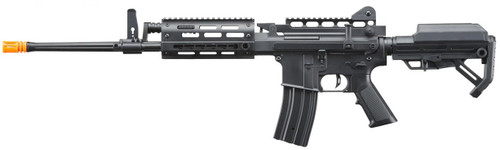
JG M4/M16 Series: The JG M4/M16 Series remains a great choice for ergonomic, point-and-shoot handling. Whether you go for the Full Metal version or the Sportline polymer tier, these airsoft guns deliver a predictable and balanced feel right out of the box. The Full Metal models add a realistic heft that really helps with immersion, while the fixed-stock M16 variants give you a stable, braced platform that’s perfect for holding down support roles. It’s a traditional handling experience that feels familiar the moment you pick it up, making it the go-to all-rounder for any field.
JG AK Variants: If you want to move on to something different, the JG AK Variants (6800 Series) are the heavy-duty alternative you need. These airsoft guns ditch the fancy stuff for a utilitarian aesthetic that’s clearly built for the mud and brush, not just sitting on a display shelf. With a weight that is notably chunky and often exceeding 6.5 lbs, these rifles provide a tactile, mechanical feedback similar to operating heavy equipment. Designed for suppressive fire, they come standard with high-capacity 500–600 round magazines so you can stay in the fight longer.
JG BAR-10 Sniper Rifle: The JG BAR-10 (JG366 / JG367) is a great start for starting a marksman journey. Its stock is finished with a signature rubberized soft-touch coating, offering a secure, high-end grip that won't slip in adverse weather. Out of the box, it features a bolt pull that is intentionally light, allowing beginners to cycle shots smoothly without breaking their sight picture. Weighing only 5–6 lbs, it remains exceptionally comfortable during the extended observation periods required for a stealth specialist.
JG Airsoft Performance Specifications
The technical foundation of the JG airsoft line is built on reinforced Version 2 and Version 3 gearboxes, featuring thick zinc-aluminum shells. While select high-tier models are equipped with high-torque neodymium magnet motors, standard versions utilize reliable ferrous-magnet motors capable of pulling M120+ springs.
When testing with 0.20g BBs, the standardized benchmarks for these platforms usually sit in the 370 and 420 FPS range. However, keep in mind that regional variants are often re-tuned specifically to meet local velocity laws. The build quality comes down to a clear distinction in materials: sportline receivers use lightweight ABS or glass-fiber reinforced polymers, while the full-metal series features heavier zinc-alloy castings.
Internally, most models utilize 8mm steel bushings rather than bearings to provide maximum durability under the tension of high-power spring sets and steel gear assemblies.
Why Players Choose JG Airsoft
While the out-of-the-box performance is solid, there are four key reasons why certain players and technicians continue to choose JG platforms over more expensive competitors.
Maximum Upgrade Potential: Many techs view a JG airsoft rifle as a blank canvas rather than just a finished product. Because the external shells and gearbox casings are widely known for being thick, sometimes beefier than those found in $400+ rifles, they’re a top-tier choice for a foundation when building high-stress sleeper builds. Whether you want to build a high-speed DSG or a dedicated long-range DMR, the frame is designed to handle the mechanical stress of aftermarket performance parts without cracking.
Universal Parts Compatibility: A major draw for enthusiasts is JG’s strict adherence to TM-Standard (Tokyo Marui) fitment. This Universal Parts Compatibility ensures you aren't locked into the proprietary hop-up units or air nozzles often found in modern boutique brands.
Field-Tested Reliability: The reputation for Field-Tested Reliability comes from the simplicity of the JG design. By forgoing integrated electronics like ETUs or MOSFETs, JG removes several common points of failure found in modern high-tech replicas.
Strong Resale Value: While they may not hold their full retail price as well as premium brands, JG models maintain a high demand within the second-hand market as project guns.
Buying Guide
Choosing the right JG airsoft model depends on balancing your preferred playstyle with the specific constraints of your local field. For those looking at the AEG line, the most critical factor is the shooting hot tendency of these airsoft guns; with stock velocities often ranging between 370 and 420 FPS.
Battery management is equally vital for AEGs, as the lack of a factory MOSFET means a 7.4V LiPo or 9.6V NiMH is the safest choice to ensure the longevity of your trigger contacts.
If you prefer a more analog and stealth-oriented role, the bolt-action JG BAR-10 offers a different path. It bypasses battery maintenance entirely and typically delivers a higher muzzle velocity of 400–450 FPS.
Ultimately, front-line players should lean toward the lightweight glass-fiber G36 or Sportline series to maintain mobility, while defensive players and snipers will benefit from the stabilized heft of the Full Metal or BAR-10 platforms.